16 Jan 2026
How a Science and Games App Improves Problem-Solving Skills?

Matthew Connor




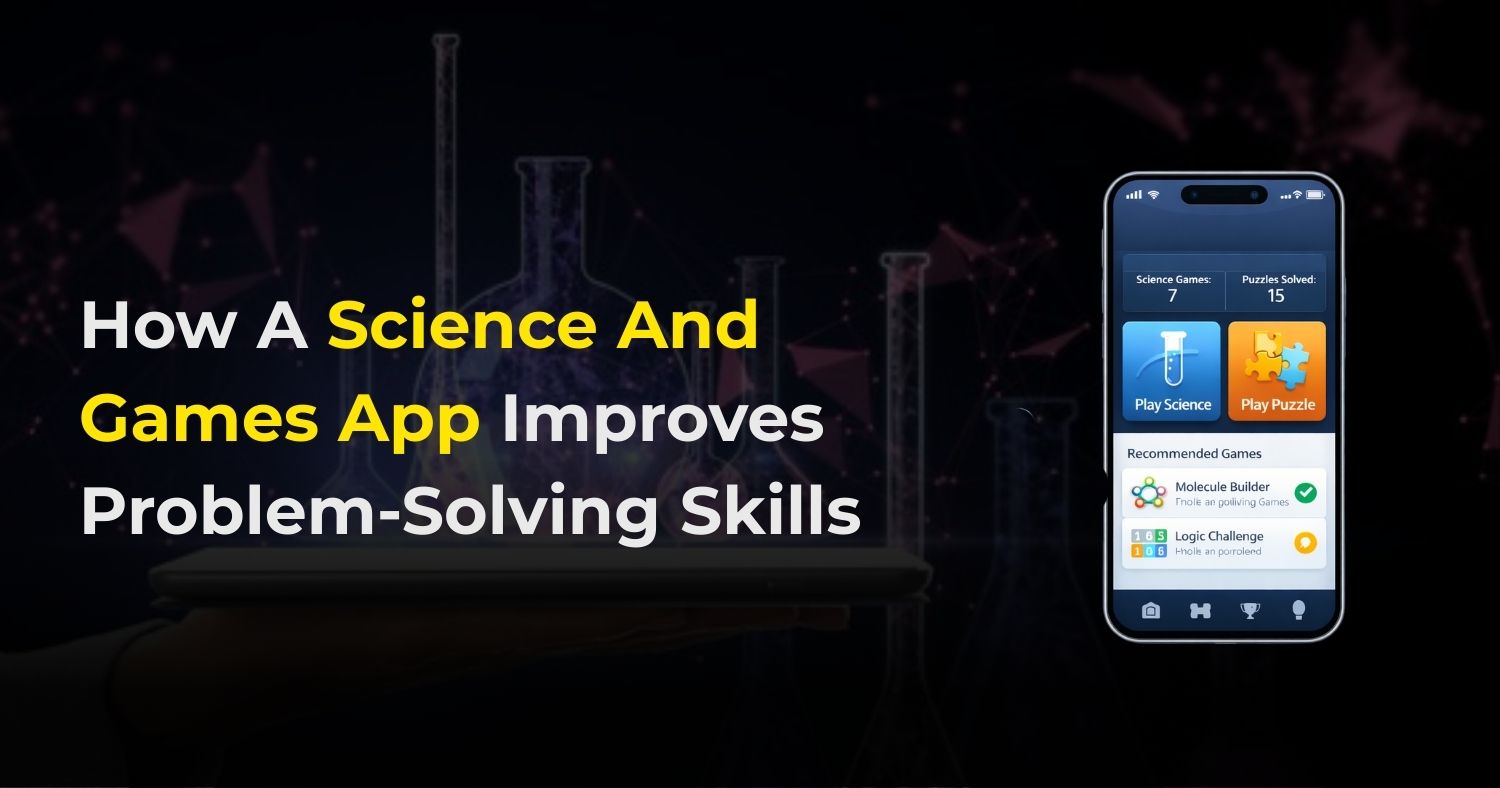
Problem-solving is one of the most important skills in today’s world. It helps people think clearly, make better decisions, and handle challenges with confidence. Whether it is a student solving math problems, a child learning logic, or an adult making daily decisions, problem-solving skills play a key role in success.
In recent years, science and games apps have become powerful tools for improving these skills. By combining learning with fun, these apps help users develop logical thinking, creativity, and analytical ability in an engaging way. Instead of boring lessons, users learn by playing, experimenting, and exploring.
What Is a Science and Games App?
A science and games app is a digital platform that combines the excitement of interactive games with the educational power of science. These apps are designed to make learning engaging, practical, and enjoyable, allowing users to explore concepts while having fun.
In the education field, mobile app development for life science plays an important role in creating apps that simulate real-world scientific scenarios. These apps are built to stimulate curiosity, develop analytical thinking, and improve problem-solving skills by encouraging users to experiment, test ideas, and learn from results rather than memorizing information.
Why Problem-Solving Skills Matter Today
Problem-solving is no longer just an academic requirement—it is a critical life skill that impacts education, career, and everyday decisions. In a rapidly changing world, the ability to analyze situations, think creatively, and find effective solutions is more important than ever.
Importance of Problem-Solving Skills:
- Helps Make Better Decisions: People who can break down problems and evaluate options are more likely to choose solutions that lead to positive outcomes.
- Improves Confidence and Independence: Solving challenges successfully builds self-belief, allowing individuals to tackle tasks without constant guidance.
- Encourages Logical and Creative Thinking: Problem-solving requires both step-by-step reasoning and innovative approaches, strengthening overall cognitive abilities.
- Supports Academic and Career Success: From science projects to workplace challenges, strong problem-solving skills improve performance, productivity, and adaptability.
- Helps Handle Real-Life Challenges: Whether it’s managing personal finances, planning projects, or resolving conflicts, problem-solving skills make daily life smoother.
How Games Help the Brain Learn Better
Games are not just for entertainment—they actively engage the brain and improve learning efficiency. Many science-based apps use game mechanics to train the brain in focus, memory, and critical thinking.
How Games Support Learning:
- Increase Attention and Focus: Games require concentration to complete challenges, remember rules, and respond quickly. This practice strengthens focus, which helps users tackle real-world tasks more efficiently.
- Improve Memory and Recall: Many games involve remembering sequences, patterns, or strategies. This repetition enhances both short-term and long-term memory, helping the brain retain and recall information better.
- Encourage Trial-and-Error Learning: Games provide a safe environment to make mistakes without real-life consequences. Users learn to test different solutions, analyze results, and improve their strategies, which builds critical thinking skills.
- Reduce Fear of Failure: In games, failing is part of the learning process. Users understand that mistakes are opportunities to learn rather than reasons to give up. This mindset encourages perseverance in problem-solving.
Key Roles of Science and Games Apps to Enhance Problem-Solving Skills
Builds Logical Thinking Step by Step
Logical thinking forms the foundation of problem-solving. Science and games apps guide users to think in a structured, step-by-step manner. By breaking down complex problems into smaller, manageable parts, users develop the ability to reason clearly and systematically.
How logical thinking improves:
- Games require users to follow rules: Users must understand and apply game rules consistently to succeed.
- Puzzles encourage step-by-step thinking: Solving puzzles develops sequential reasoning and analytical skills.
- Challenges need planning and strategy: Users plan actions carefully to achieve goals efficiently.
- Users learn to predict outcomes: By experimenting and observing results, users develop predictive thinking.
- Enhances cause-and-effect understanding: Users connect actions with outcomes, improving logical reasoning for real-world scenarios.
Over time, this structured approach to thinking becomes second nature and transfers to real-life problem-solving.
Encourages Critical Thinking
Critical thinking involves analyzing problems from multiple angles. Science and games apps built with life science mobile app development principles present open-ended challenges that encourage flexible thinking.
Ways apps improve critical thinking:
- Present open-ended challenges: Users are required to think creatively and evaluate multiple solutions.
- Offer multiple ways to solve a problem: Encourages flexibility and adaptability.
- Ask users to analyze results: Feedback helps users reflect and learn from outcomes.
- Encourage questioning and curiosity: Promotes exploration and deeper understanding.
- Supports hypothesis testing: Users make predictions, test them, and adjust strategies based on evidence.
By guiding users to think critically rather than providing immediate answers, these apps foster independent and analytical thinking.
Improves Decision-Making Skills
Many games require fast yet smart decision-making under time or resource constraints. Players must weigh options, anticipate consequences, and choose the best path, which strengthens decision-making ability.
Decision-making benefits:
- Teaches cause-and-effect thinking: Users learn how their choices impact outcomes.
- Helps evaluate risks and rewards: Strategic gameplay teaches balancing short-term and long-term consequences.
- Improves confidence in choices: Success reinforces self-belief and willingness to make decisions independently.
- Builds responsibility for outcomes: Users understand that every decision has a result, promoting accountability.
- Encourages prioritization: Users learn to focus on the most important actions first.
These decision-making skills are transferable to academics, career challenges, and everyday life situations.
Develops Scientific Thinking
Science and games apps often simulate experiments, letting users act like scientists in a virtual environment. This encourages exploration, observation, and reasoning.
Scientific thinking skills gained:
- Asking questions: Users identify problems and generate curiosity-driven questions.
- Making predictions: Users hypothesize outcomes before testing ideas.
- Testing ideas: Interactive simulations allow safe experimentation.
- Learning from results: Feedback helps users analyze results and improve future performance.
- Applying logic to real scenarios: Skills learned in apps can be applied in academic or real-world experiments.
This process improves analytical skills and develops a systematic approach to problem-solving.
Makes Learning Active Instead of Passive
Traditional learning often relies on reading or listening, which can be passive. Science and games apps make learning active, engaging, and hands-on.
Active learning benefits:
- Users interact with content: Engaging with challenges helps retain knowledge better.
- Learning becomes hands-on: Simulations, puzzles, and interactive tools promote practical understanding.
- Concepts are understood deeply: Users see principles in action rather than memorizing facts.
- Retention improves: Active engagement improves memory and skill application.
- Encourages exploration: Users learn through discovery, which makes problem-solving more intuitive.
Active learning ensures users are mentally involved and develop critical problem-solving abilities efficiently.
Boosts Creativity and Innovation
Problem-solving is not only logical but also creative. Science and games apps encourage out-of-the-box thinking and innovative solutions.
How creativity improves:
- Games allow multiple solutions: Users are encouraged to experiment with different approaches.
- Users experiment freely: Safe virtual environments reduce fear of mistakes.
- Mistakes are part of learning: Trial and error teach resilience and adaptability.
- New ideas are encouraged: Users develop unique solutions that can be applied in other contexts.
- Promotes lateral thinking: Encourages finding connections between unrelated concepts.
Creative thinking enhances the ability to solve complex problems in innovative ways.
Helps Learn from Mistakes
Mistakes are essential in learning problem-solving. Science and games apps create a safe environment for users to fail and learn.
Learning through mistakes:
- No fear of judgment: Mistakes in apps do not have real-world consequences.
- Instant feedback: Users understand what went wrong and how to fix it.
- Encourages retrying: Multiple attempts reinforce learning.
- Builds resilience: Users learn to persevere through challenges.
- Promotes continuous improvement: Each mistake becomes a learning opportunity.
Users gradually develop confidence in facing real-world challenges.
Improves Focus and Patience
Many games require sustained effort to complete challenges, which improves focus and patience over time.
Focus-related benefits:
- Longer attention span: Users learn to stay engaged for extended periods.
- Better task completion: Completing multi-step challenges enhances discipline.
- Improved self-control: Users learn to manage distractions and stay on track.
- Stronger mental discipline: Regular gameplay trains the mind to approach problems methodically.
- Reduces impulsive decisions: Encourages thoughtful, measured responses.
These qualities are critical for tackling complex academic, professional, or personal problems.
Supports Different Learning Styles
Science and games apps cater to visual, auditory, and kinesthetic learners, making them effective for diverse audiences. Many advanced solutions developed by companies like Whitehall Technologies focus on adaptive and user-friendly learning experiences.
Learning style support:
- Visual animations and diagrams: Interactive graphics, flowcharts, and visual cues help users understand complex concepts quickly.
- Sound-based instructions: Narration, music, and sound effects guide auditory learners, reinforcing memory and comprehension.
- Interactive tasks: Hands-on activities, drag-and-drop puzzles, and simulations engage kinesthetic learners who learn best by doing.
- Self-paced learning: Users can progress at their own speed, revisiting concepts they find challenging without feeling rushed.
- Adaptive learning paths: Some apps adjust difficulty levels based on user performance, offering personalized challenges that match learning ability.
- Combination of styles: Many science and games apps combine visuals, audio, and interactive elements to create a multi-sensory experience that strengthens retention.
This flexibility helps users understand problems in ways that suit them best, making learning more enjoyable, effective, and long-lasting.
Builds Confidence in Problem-Solving
Confidence is essential for tackling new challenges and thinking creatively. Science and games apps gradually build this confidence by allowing users to succeed in progressively difficult tasks, giving them a sense of achievement and mastery.
Confidence benefits:
- Willingness to try harder problems: Users become more open to attempting complex challenges without hesitation.
- Reduced fear of failure: Games provide a safe space to fail, retry, and learn, making mistakes part of the learning process.
- Improved self-belief: Completing challenges boosts self-esteem and reinforces the idea that effort leads to results.
- Better performance in real-life tasks: Users apply the problem-solving strategies and resilience learned in games to academic, professional, or personal challenges.
- Encourages risk-taking and exploration: Confident users are more likely to experiment with creative solutions rather than sticking to safe, predictable answers.
- Supports long-term learning habits: Positive reinforcement from successful gameplay motivates continued practice and learning.
By nurturing confidence alongside cognitive skills, science and games apps help users become independent, proactive, and effective problem-solvers.
Conclusion
Science and games apps are powerful tools for improving problem-solving skills. By combining learning with play, they help users think logically, act creatively, and solve problems with confidence. From children to adults, these apps support mental growth, curiosity, and lifelong learning.
In a world that values smart thinking and quick solutions, using a science and games app is a simple and effective way to build strong problem-solving skills.
Frequently Asked Questions
Related Posts

24 Feb 2026
How Much Does it Cost to Build an AI Powered Dating App in the USA
AI is changing online dating. Apps now use AI to study behavior, interests, and chats for better matches and safer experiences. Things like spotting f..
Matthew Connor

29 Jan 2026
How Custom AI Chatbot Development Services Can Boost Your Sales and Support
In today’s fast-paced digital world, custom AI chatbot development services can significantly enhance both sales and customer support for businesses o..
Matthew Connor
Join the newsletter and get all the updates.
Subscribe
 +1 (443) 454-3676
 sales@whitehalltechnologies.com
 501 East Las Olas Blvd., Suite 200 and 300, Fort
Lauderdale, Florida, FL 33301
501 East Las Olas Blvd., Suite 200 and 300, Fort
Lauderdale, Florida, FL 33301


