24 Jan 2026
Augmented Reality Applications Process in 2026: Trends, Challenges, and Solutions

Matthew Connor




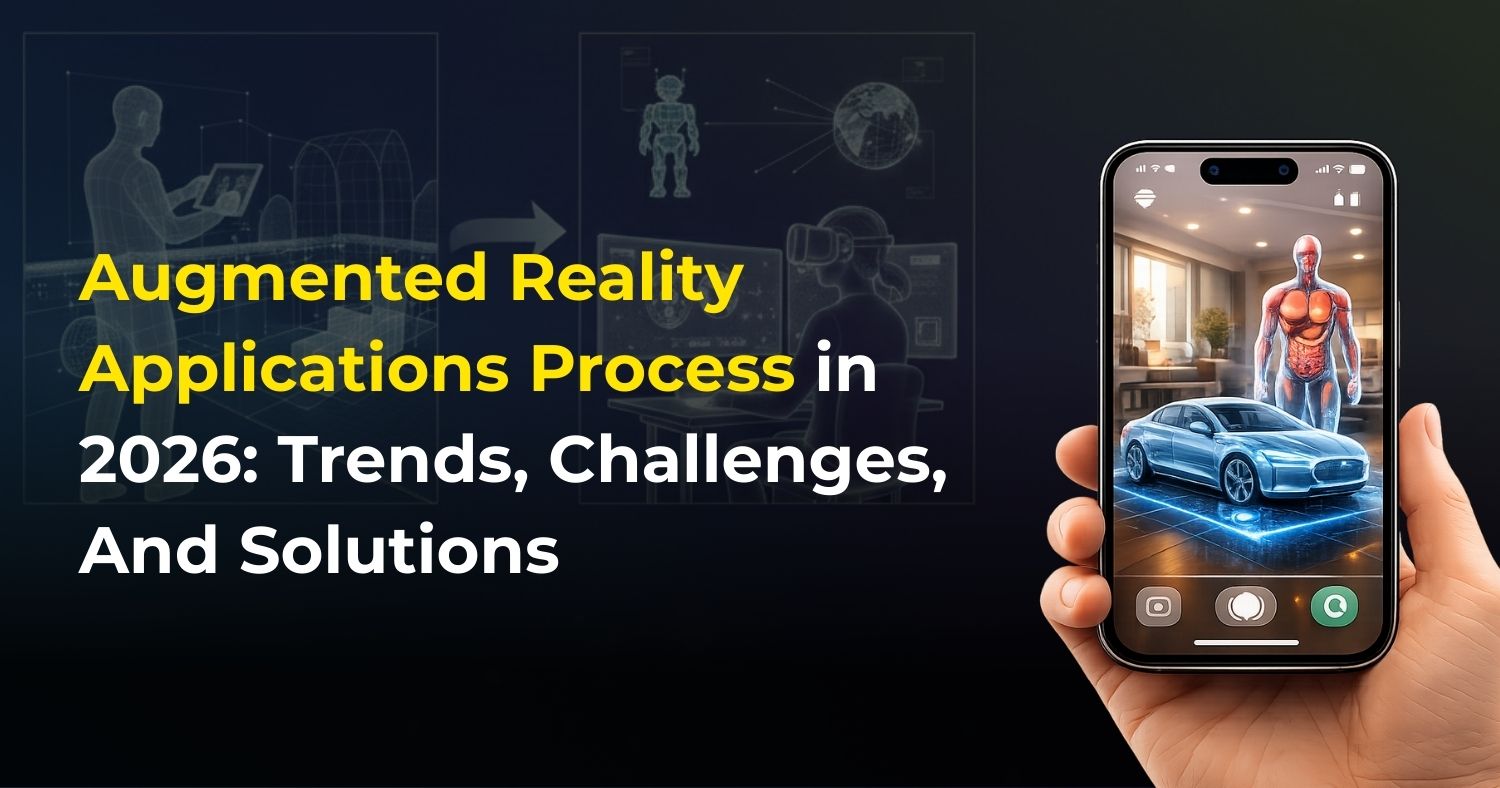
The augmented reality applications process is no longer a futuristic concept. By 2026, AR applications have become a core part of how businesses, schools, healthcare providers, and consumers interact with digital content. From immersive learning environments to real-time product visualization, AR is transforming how people experience the digital and physical worlds together.
As technology continues to evolve, AR development has become more structured, strategic, and user-focused. Businesses now move beyond basic features and focus on real-world value, scalability, and seamless user experiences. This blog explains the complete development journey in 2026, the latest trends shaping the industry, key challenges developers face, and practical solutions to overcome them.
Whether you are a business owner, educator, or tech enthusiast, understanding how AR solutions are built will help you make informed and future-ready decisions.
What Is Augmented Reality in 2026?
Augmented Reality overlays digital elements such as images, animations, sounds, or data onto the real-world environment using devices like smartphones, tablets, AR glasses, or headsets. Unlike virtual reality, AR does not replace the real world—it enhances it.
In 2026, AR has become more realistic, faster, and easier to access. Improvements in AI, 5G, cloud computing, and wearable devices have made AR smoother and more interactive than ever before. Industries such as retail, healthcare, real estate, manufacturing, and especially in education are widely adopting AR solutions to improve engagement and efficiency.
Augmented Reality Applications Development Process in 2026
The augmented reality applications process in 2026 follows a clear, well-defined structure designed to deliver strong performance, high usability, and long-term value. Each stage focuses on user experience, technical stability, and scalability.
Step 1: Idea Validation and Use Case Planning
Every successful AR application begins with a clear idea, defined goals, and practical use cases. This stage ensures the augmented reality applications process starts with real user needs and measurable outcomes.
Key Questions to Answer:
- What problem will the AR app solve?
- Who is the target audience?
- Which industry will it serve?
- What value will users gain from the AR experience?
- How will AR improve existing processes or learning methods?
Also Read: Benefits of augmented reality in education
Step 2: Market Research and Competitor Analysis
In 2026, the AR market is highly competitive. Proper market research helps businesses identify gaps, trends, and opportunities before investing in development.
This Step Includes:
- Studying existing AR apps in the same industry
- Understanding user expectations and pain points
- Analyzing competitors’ strengths and weaknesses
- Identifying current and emerging technology trends
- Reviewing pricing, features, and user feedback
This research allows businesses to design unique AR solutions that solve real problems instead of copying existing applications.
Step 3: Choosing the Right AR Technology Stack
Selecting the right technology stack is a critical part of the augmented reality applications process, ensuring smooth performance, security, and future scalability.
Common AR Technologies Used in 2026:
- ARKit and ARCore for mobile-based AR experiences
- Unity and Unreal Engine for immersive and interactive content
- AI-powered object, image, and gesture recognition
- Cloud-based AR services for real-time updates
- Wearable device and AR glasses compatibility
Many businesses work with an experienced AR App Development Company in the USA to select the best technology stack based on project goals, budget, and target platforms.
Step 4: UI/UX Design for AR Applications
AR UI/UX design is different from traditional app design because it blends digital content with the real world. The goal is to make interactions natural, intuitive, and distraction-free.
UI/UX Design Priorities:
- Clean and minimal interface design
- Easy navigation and smooth transitions
- Natural gestures and movement-based controls
- Clear instructions and visual guidance
- Accessibility for users of all age groups
In augmented reality in education, good UI/UX design ensures students focus on learning concepts instead of struggling with controls or confusing layouts.
Step 5: 3D Content Creation and Asset Development
High-quality 3D content forms the core of any AR application. Realistic and accurate visuals significantly improve user engagement and understanding.
This Includes:
- Detailed 3D models
- Smooth animations
- High-quality textures
- Interactive learning or product elements
In 2026, AI-assisted 3D modeling tools help reduce development time while improving realism. Educational AR apps use interactive 3D visuals to explain complex topics such as anatomy, chemistry, physics, geography, and engineering concepts more effectively.
Step 6: AR App Development and Integration
This phase transforms designs and assets into a functional AR application. Developers focus on performance, accuracy, and seamless interaction.
Core Development Activities:
- Coding AR logic and interactions
- Integrating cameras, sensors, and GPS
- Implementing real-time object and surface tracking
- Adding AI features and analytics tools
- Connecting backend systems and databases
Developers also ensure smooth performance across smartphones, tablets, and AR wearables to deliver a consistent experience on all supported devices.
Step 7: Testing and Quality Assurance
Testing AR applications is more complex than traditional apps because they interact with real-world environments.
Types of Testing in 2026:
- Device compatibility testing
- Performance and stability testing
- User interaction and usability testing
- Environmental and lighting condition testing
- Security and data protection testing
This step ensures the app performs reliably across different devices, environments, and real-world conditions.
Step 8: Deployment and Launch
Once testing is complete, the AR app is prepared for launch. Deployment strategies depend on the target audience and industry.
Deployment Channels:
- Mobile app stores
- Enterprise and internal systems
- Educational platforms and learning portals
- Web-based AR solutions
Post-launch monitoring is essential to track performance, user engagement, technical issues, and overall app success.
Step 9: Maintenance and Continuous Improvement
AR applications require ongoing updates to remain effective and competitive in 2026.
Ongoing Activities:
- Bug fixes and security updates
- Feature enhancements and upgrades
- Performance optimization
- Content expansion and updates
- Analytics-based improvements
This is especially important for AR in education, where curriculum updates, new learning modules, and evolving educational standards require continuous improvements.
Key AR Application Trends in 2026
AI-powered AR, wearable devices, WebAR, real-time collaboration, and AR in retail are redefining how the augmented reality applications process delivers smarter, more accessible, and value-driven experiences across industries.
- AI-Powered AR Experiences: Artificial Intelligence is making AR applications more intelligent and user-focused. AI-powered AR can recognize objects instantly, understand voice commands, and adapt content based on user behavior. This creates personalized experiences in shopping, healthcare, education, and gaming. For example, AR apps can recommend products, guide users step-by-step, or adjust visuals in real time based on surroundings.
- Wearable AR Devices: AR glasses and headsets are becoming more compact, lightweight, and affordable. These devices offer hands-free interaction, making them ideal for industries like manufacturing, healthcare, logistics, and field services. Wearable AR helps professionals access instructions, data overlays, and live support without stopping their work, improving productivity and safety.
- AR in Education Expansion: Educational institutions are increasingly using AR to create interactive learning environments. Students can explore 3D models, virtual labs, and real-world simulations directly from classrooms or homes. AR enhances understanding, improves engagement, and supports remote and skill-based learning, making education more practical and immersive.
- Web-Based AR Growth: WebAR is gaining popularity because it removes the need to download apps. Users can access AR experiences directly through browsers using smartphones or tablets. This trend helps businesses reach more users, improve engagement, and reduce friction, especially in marketing, e-commerce, and virtual product demonstrations.
- Real-Time Collaboration in AR: Real-time AR collaboration allows multiple users to interact within the same virtual space. This is especially useful for remote teamwork, training sessions, design reviews, and education. Teams can share ideas, make changes, and solve problems together, even from different locations.
- AR in Retail and E-Commerce: AR is transforming online shopping by allowing customers to visualize products before purchasing. Users can try on clothes, preview furniture in their homes, or test products virtually. This improves confidence, reduces returns, and enhances the overall shopping experience.
Challenges in Augmented Reality Application Development
- High Development Costs: Building high-quality AR applications requires advanced tools, skilled developers, 3D designers, and extensive testing. Creating realistic 3D models, accurate object tracking, and smooth interactions increases both development time and cost. Small businesses may find it difficult to invest in AR without clear short-term returns, making budget planning a major challenge.
- Device Compatibility Issues: AR applications must work across a wide range of devices, including smartphones, tablets, and wearable hardware. Different operating systems, camera qualities, sensors, and processing capabilities affect how AR performs. Ensuring consistent performance across devices requires extra optimization, testing, and development effort.
- User Adoption Barriers: Not all users are familiar with augmented reality technology. Some may find AR applications confusing, uncomfortable, or unnecessary. Poor user interface design or a lack of clear guidance can lead to low engagement. Developers must focus on intuitive design, easy onboarding, and clear instructions to improve user acceptance.
- Data Privacy and Security Concerns: AR applications often collect sensitive data such as camera input, facial recognition data, and location details. This raises privacy and security concerns among users. Developers must implement strong data protection measures, follow privacy regulations, and be transparent about data usage to build user trust.
- Performance and Battery Limitations: AR applications rely heavily on real-time processing, sensors, and graphics rendering. This can lead to high battery consumption, device overheating, and performance lag. Optimizing AR apps to run smoothly without draining resources remains a major technical challenge.
Why Businesses Should Invest in AR Applications Now
By 2026, investing in AR through a structured augmented reality applications process is a competitive necessity. Businesses benefit from higher engagement, improved conversions, reduced training costs, stronger brand visibility, and faster decision-making.
Business Benefits:
- Improved customer engagement: Interactive AR experiences keep users involved longer and increase brand recall.
- Higher conversion rates: Virtual product previews and real-time visualization help customers make confident buying decisions.
- Reduced training costs: AR-based training modules minimize the need for physical resources and repeated instructor-led sessions.
- Better brand visibility: Businesses using AR stand out as modern, innovative, and customer-focused.
- Data-driven insights: AR apps collect valuable user behavior data that helps refine marketing, product design, and customer experience strategies.
- Faster decision-making: Visual simulations help customers and employees understand complex information quickly.
As consumer expectations continue to rise, businesses that delay AR adoption risk falling behind competitors who already offer immersive digital experiences. Partnering with a trusted AR App Development Company ensures professional execution, scalable architecture, future-ready solutions, and long-term success in an increasingly AR-driven market.
Conclusion
The augmented reality applications process in 2026 is more advanced, structured, and user-focused than ever before. From idea validation to continuous optimization, each step plays a vital role in delivering meaningful AR experiences. Emerging trends like AI integration, wearable devices, and WebAR are expanding possibilities across industries.
While challenges such as cost, compatibility, and security exist, modern tools and best practices provide effective solutions. Industries like education are seeing massive transformation, proving the real-world value of AR technology. Businesses and institutions that invest in AR today will be better positioned for growth, innovation, and long-term success in the digital future.
Frequently Asked Questions
Related Posts
23 Sep 2025
How To Build Social Media App with Next Gen AI Power
The social media space is a crowded attention marketplace, with many platforms targeting user engagement. Building a new social app in this ecosystem ..
Matthew Connor
4 Mar 2025
Ultimate Guide to Building an AI App Step-by-Step
Artificial Intelligence (AI) is revolutionizing the world by making technology more efficient and companies more productive. From robotics that can pe..
Matthew Connor
Join the newsletter and get all the updates.
Subscribe
 +1 (443) 454-3676
 sales@whitehalltechnologies.com
 501 East Las Olas Blvd., Suite 200 and 300, Fort
Lauderdale, Florida, FL 33301
501 East Las Olas Blvd., Suite 200 and 300, Fort
Lauderdale, Florida, FL 33301


