30 Jan 2026
Updated on February 17th, 2026
Electric Vehicle Software Development Guide: Features, Cost & Benefits

Matthew Connor




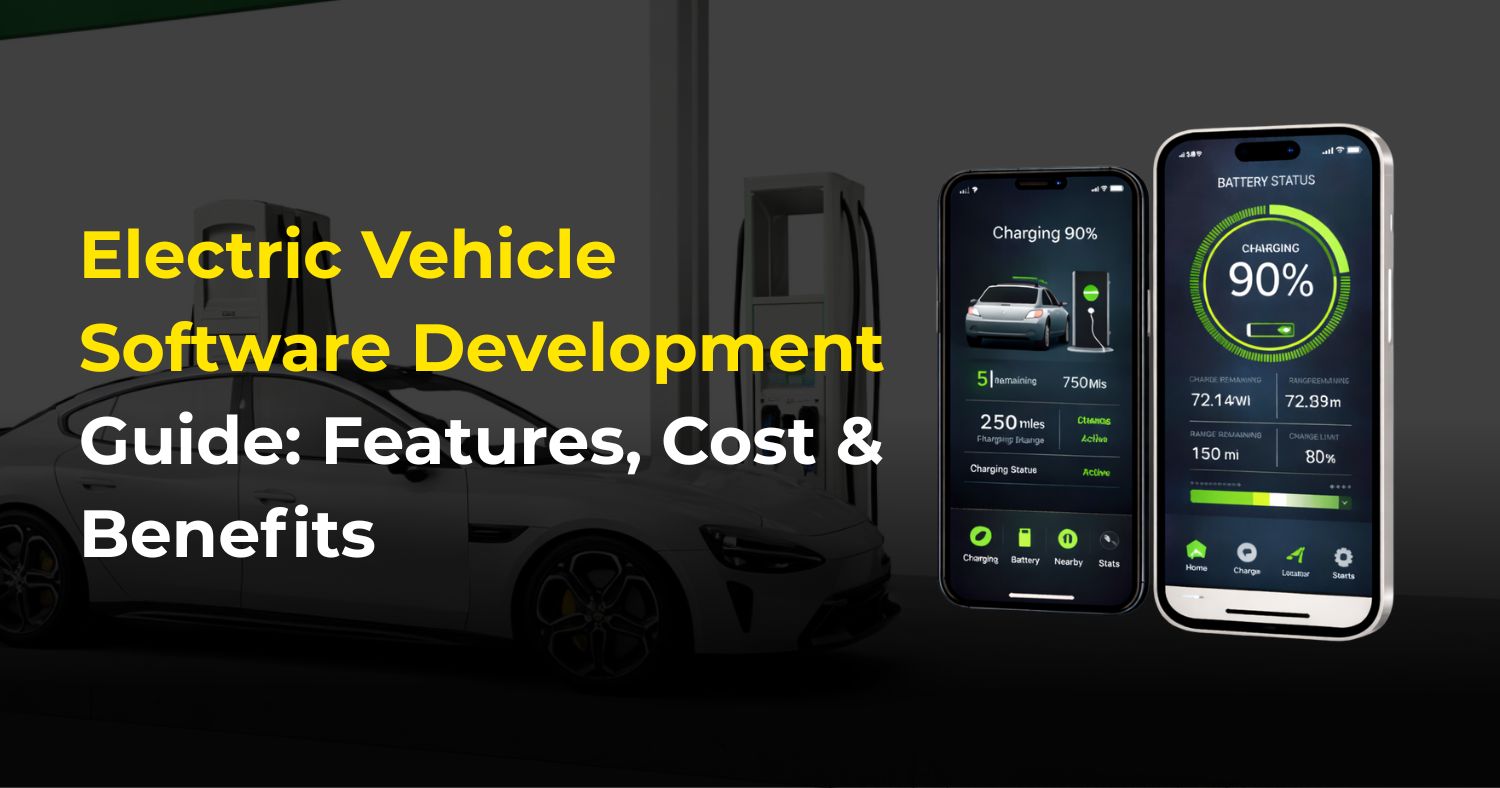
Electric Vehicle Software Development is the backbone of modern electric vehicles, enabling smarter battery management, safer driving, seamless connectivity, and real-time performance monitoring. If you want to understand how EV software works, what features it includes, how much it costs, and why it matters, this guide gives you clear and practical answers.
As electric vehicles continue to transform the global automotive industry, software has become just as important as hardware. From managing battery efficiency and motor control to supporting navigation, infotainment, and autonomous driving, EV software ensures vehicles operate safely, efficiently, and intelligently. Automakers and startups are increasingly investing in advanced EV software solutions to improve driving experience, reduce maintenance costs, and meet future mobility demands.
Types of Electric Vehicle Software Development
EV software is the heart of modern EVs. It ensures every system in the vehicle—from the battery to the motor to the infotainment—is optimized for performance, safety, and user experience. In the US market, EV software development has become a major focus for automakers like Tesla, Rivian, Lucid Motors, and Ford. EV software can be broadly classified into the following categories:
Battery Management System (BMS) Software
The Battery Management System (BMS) monitors and manages the battery pack to ensure maximum efficiency, safety, and longevity. It is one of the most critical components in EV software.
Key Functions:
- Battery Monitoring: Tracks charge levels, temperature, voltage, and current in real time to prevent failures.
- Safety Management: Prevents overheating, overcharging, or deep discharging, which can damage cells.
- Energy Optimization: Balances power consumption for better driving range.
- Predictive Analytics: Estimates remaining battery life and predicts potential faults before they occur.
Practical Benefits:
- Increases battery lifespan by 20–30% through optimized charging cycles.
- Provides drivers with real-time updates on battery health.
- Reduces the risk of fire or damage due to faulty charging.
Motor Control Software
Motor control software manages the electric motor’s performance to ensure smooth acceleration, energy efficiency, and safety.
Key Functions:
- Speed & Torque Control: Optimizes performance for city driving, highway cruising, or off-road use.
- Regenerative Braking: Recaptures energy during braking and sends it back to the battery.
- Power Distribution: Manages torque for dual-motor or all-wheel-drive EVs.
- Performance Monitoring: Tracks efficiency and detects issues in real time.
Practical Benefits:
- Enhances driving comfort with smooth acceleration and deceleration.
- Improves energy efficiency, extending driving range.
- Reduces wear and tear on mechanical components.
Infotainment and Connectivity Software
Infotainment software keeps drivers and passengers connected while improving convenience and entertainment options.
Key Functions:
- Navigation & Maps: Delivers real-time traffic information and optimizes routes according to battery range.
- Media & Apps: Supports music streaming, podcasts, and other digital entertainment.
- Smartphone Integration: Allows users to monitor the EV remotely, control the climate, and schedule charging.
- Over-the-Air (OTA) Updates: Delivers bug fixes and new features without visiting a service center.
Practical Benefits:
- Enhances user experience through intuitive interfaces and mobile apps.
- Reduces the need for manual software updates.
- Helps drivers plan trips with real-time range and charging station data.
The Best EV Charging App Development Company in the USA specializes in integrating these connectivity features with real-time charging station data to enhance the EV ecosystem.
Autonomous Driving Software
Autonomous driving software allows EVs to operate partially or fully autonomously using AI, machine learning, and advanced sensors.
Key Functions:
- Lane-Keeping Assistance: Keeps the vehicle safely within lanes.
- Adaptive Cruise Control: Maintains safe distances from other vehicles.
- Automated Parking: Assists with parallel and perpendicular parking.
- Collision Avoidance: Uses sensors and AI to prevent accidents.
Practical Benefits:
- Reduces driver fatigue on long journeys.
- Improves road safety by reducing human error.
- Prepares vehicles for future fully autonomous operations.
Vehicle-to-Everything (V2X) Software
V2X software enables communication between EVs, infrastructure, and other vehicles for safer and smarter driving.
Key Functions:
- Vehicle-to-Vehicle (V2V): Shares information about speed, position, and hazards.
- Vehicle-to-Infrastructure (V2I): Communicates with traffic lights, charging stations, and road sensors.
- Vehicle-to-Grid (V2G): Supports bidirectional energy flow, enabling EVs to send power back to the electrical grid.
Practical Benefits:
- Reduces accidents by providing early warnings about traffic conditions.
- Optimizes traffic flow in smart cities.
- Supports energy efficiency through V2G capabilities.
Key Features of Electric Vehicle Software Development
Developing efficient and user-friendly EV software requires incorporating features that enhance vehicle performance, safety, and driver experience. These features not only ensure the smooth operation of electric vehicles but also help in prolonging battery life, improving energy efficiency, and providing convenience to users.
- Battery Management: Battery management is one of the most critical components of EV software. It ensures that the vehicle’s battery operates at optimal levels while extending its lifespan. Advanced systems provide real-time battery monitoring, allowing drivers to track charge levels, energy consumption, and range estimates accurately. Charging optimization features automatically adjust charging speed and power usage depending on battery condition and grid availability, preventing overcharging and overheating. Additionally, battery health analytics provide insights into degradation patterns, alerting users to maintenance needs and helping manufacturers design better battery systems in the future.
- Vehicle Performance Optimization: Optimizing vehicle performance ensures a smoother, safer, and more efficient driving experience. EV software can track motor efficiency to maximize energy output and reduce wastage. Regenerative braking management captures kinetic energy during braking and converts it back into usable battery power, improving range and reducing wear on mechanical components. Drive mode selection, such as Eco, Sport, and Normal, allows users to adjust vehicle behavior according to road conditions, energy efficiency goals, or driving preferences. These features collectively enhance both performance and sustainability.
- Navigation and Smart Connectivity: Navigation and smart connectivity features enhance convenience and efficiency for EV drivers. GPS-based route optimization helps plan trips based on real-time traffic data, energy consumption, and shortest routes. Charging station recommendations guide drivers to the nearest or most suitable charging points, reducing range anxiety. Smartphone app integration enables remote control of vehicle functions, such as pre-conditioning cabin temperature, checking battery status, or scheduling charging, making daily EV use seamless and user-friendly.
- Safety Features: Safety is a top priority in EVs, and modern software integrates multiple features to protect drivers and passengers. Anti-lock braking systems (ABS) prevent wheel lock-up during sudden braking, while electronic stability control helps maintain vehicle stability during sharp turns or slippery conditions. Collision detection and alert systems warn drivers of potential hazards in real time, sometimes even initiating automatic braking to prevent accidents. These advanced safety systems, combined with predictive analytics, ensure both proactive and reactive protection on the road.
- Infotainment & User Interface: EV software enhances user interaction through modern infotainment and user interface systems. Touchscreen control panels allow intuitive access to vehicle settings, navigation, and multimedia options. Voice command functionality enables hands-free operation of essential features, improving safety while driving. Multimedia streaming, app integration, and personalized user profiles create a connected and enjoyable driving experience. Additionally, customizable dashboards allow drivers to monitor key metrics like energy consumption, battery health, and performance data in real time.
- Over-the-Air (OTA) Updates: OTA updates revolutionize how EV software is maintained and improved. These updates allow manufacturers to remotely fix software bugs, improve system performance, and introduce new features without requiring a visit to a service center. OTA capabilities reduce downtime, ensure that vehicles remain up-to-date with the latest safety and performance enhancements, and enable continuous improvement of the user experience. Over time, this also helps extend the overall life of the vehicle and keeps it compatible with emerging technologies.
Steps in Electric Vehicle Software Development
Developing software for EVs requires careful planning, testing, and execution. Here’s a step-by-step approach:
Step 1: Requirement Gathering
- Understand vehicle type, market, and customer needs
- Define software functionalities like battery management, navigation, or safety systems
Step 2: System Design
- Create architecture for hardware-software integration
- Decide on embedded systems, cloud integration, and apps
Step 3: Software Development
- Coding software modules for battery, motor, infotainment, and safety
- Developing mobile apps and web dashboards for monitoring
Step 4: Testing & Simulation
- Test software performance in simulators and real vehicles
- Validate safety features and battery optimization
Step 5: Deployment
- Install software in EVs
- Enable OTA updates for continuous improvements
Step 6: Maintenance & Updates
- Monitor performance data
- Provide bug fixes and new features
Cost of Electric Vehicle Software Development
The cost to develop Electric Vehicle software varies depending on complexity, vehicle type, and features. Here is a rough estimate:
| Type of Software | Development Cost (USD) |
| Battery Management System (BMS) | 20,000 – 50,000 |
| Motor Control Software | 15,000 – 40,000 |
| Infotainment & Connectivity | 30,000 – 100,000 |
| Autonomous Driving Modules | 100,000 – 500,000 |
| Mobile App & Dashboard | 10,000 – 50,000 |
Factors Affecting the Cost of EV Software Development
Several key factors influence the overall development cost of electric vehicle software:
- Complexity of Features: Advanced features such as predictive analytics, AI-driven battery management, or autonomous driving significantly increase development time and costs compared to basic monitoring systems.
- Integration with Hardware: EV software must seamlessly integrate with sensors, ECUs (Electronic Control Units), motor controllers, and battery systems. The more complex the hardware ecosystem, the higher the integration cost.
- Level of Autonomous Driving: Software for Level 2 or Level 3 autonomous driving requires sophisticated algorithms, sensor fusion, and real-time decision-making capabilities, making it one of the most expensive modules to develop.
- Cloud Services and OTA Capabilities: Cloud connectivity for remote diagnostics, vehicle updates, and data analytics adds to both development and ongoing operational costs. Over-the-Air (OTA) update systems also require secure, reliable infrastructure.
- Security Requirements: Protecting EV systems from cyber threats is critical. Software must implement robust encryption, secure communication protocols, and cybersecurity testing, all of which increase development expenses.
Working with an experienced electric vehicle software development company ensures proper cost estimation and high-quality results.
Benefits of Electric Vehicle Software Development
Investing in robust EV software provides significant advantages for drivers, manufacturers, and the environment:
- Improved Battery Efficiency: Optimized charging and energy usage extend battery life and reduce downtime.
- Enhanced Vehicle Safety: Real-time monitoring, collision detection, and predictive alerts reduce accidents.
- Better Driving Experience: Smooth acceleration, regenerative braking, and customizable drive modes enhance comfort.
- Smart Connectivity: Mobile apps, navigation, and OTA updates provide convenience and a seamless digital experience.
- Cost Savings: Predictive maintenance and energy optimization lower long-term operational costs.
- Sustainability: Efficient battery and motor management reduce energy wastage and carbon footprint.
- Future-Ready: Integration of AI, V2X, and autonomous features prepares vehicles for next-gen mobility.
Read More: Develop An EV Charging Station Finder App Like PlugShare
Future Trends in EV Software
EV software is evolving rapidly. Key trends include:
- Artificial Intelligence (AI) and Machine Learning: For predictive maintenance and autonomous driving
- Vehicle-to-Everything (V2X): Connected vehicles communicate with traffic and infrastructure
- Over-the-Air (OTA) Updates: Continuous software improvements without service visits
- Blockchain for EV Charging: Secure and transparent charging transactions
- Smart Fleet Management: Optimized routes, battery usage, and predictive maintenance for commercial EVs
Conclusion
Electric vehicle software development is at the heart of the modern EV revolution. From managing battery performance and motor efficiency to enhancing safety, connectivity, and user experience, EV software ensures that electric vehicles are not only sustainable but also intelligent and reliable. The cost of developing EV software depends on complexity, integration requirements, autonomous driving capabilities, cloud services, and security measures, with investments ranging from tens of thousands to several hundred thousand dollars per module.
Frequently Asked Questions
Related Posts

24 Feb 2026
How Much Does it Cost to Build an AI Powered Dating App in the USA
AI is changing online dating. Apps now use AI to study behavior, interests, and chats for better matches and safer experiences. Things like spotting f..
Matthew Connor

29 Jan 2026
How Custom AI Chatbot Development Services Can Boost Your Sales and Support
In today’s fast-paced digital world, custom AI chatbot development services can significantly enhance both sales and customer support for businesses o..
Matthew Connor
Join the newsletter and get all the updates.
Subscribe
 +1 (443) 454-3676
 sales@whitehalltechnologies.com
 501 East Las Olas Blvd., Suite 200 and 300, Fort
Lauderdale, Florida, FL 33301
501 East Las Olas Blvd., Suite 200 and 300, Fort
Lauderdale, Florida, FL 33301


